

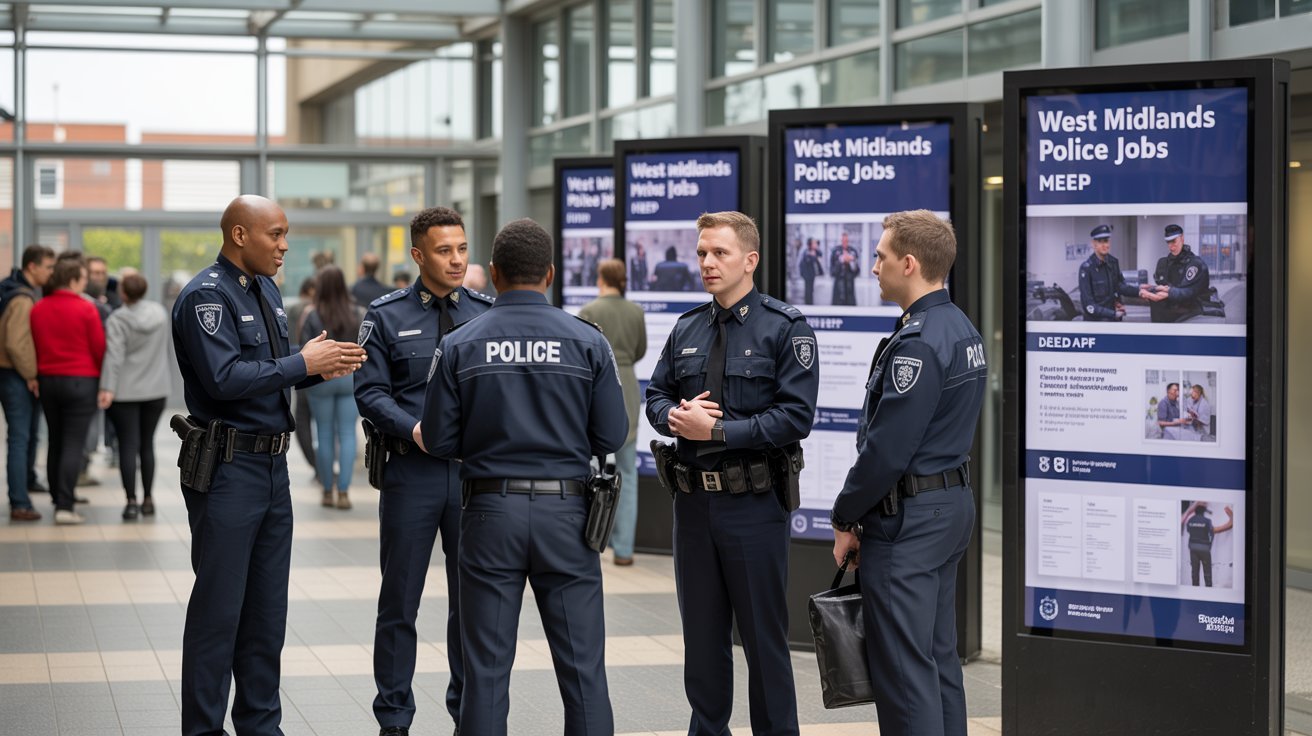
Key takeaways
- A new West Midlands Police constable starts on £32,255 a year (pay point 1, from 1 September 2026; provisional — see the pay section), rising to £52,015 at the top of the constable scale.
- You do not need a degree: the Police Constable Entry Programme (PCEP) is direct entry. The four College routes are PCDA, DHEP, PCEP and the pre-join policing degree.
- Assessment is four stages: national application form → online National Sift → Online Assessment Centre → in-person interview — then medical, bleep test to level 5.4, and vetting.
- You normally need three years’ continuous UK residence, and UK/EEA nationality or indefinite leave to remain. Since July 2026 some cautions and convictions bar automatically.
- Apply through WMP Jobs (jobs.west-midlands.police.uk) — not through the PCC’s office vacancies page, which the old version of this guide linked to by mistake.
- 150 new neighbourhood officers + 20 PCSOs were secured in April 2025 under the Neighbourhood Policing Guarantee; a July 2026 update reports 351 extra neighbourhood officers in the past year. These are staffing figures, not a live vacancy count.
On this page
- West Midlands Police jobs in 2026: routes, pay and how to apply
- West Midlands Police recruitment in 2026: what has changed
- Routes into policing: the four entry routes
- West Midlands Police pay in 2026: starting salary and progression
- What new recruits can expect
- What the job actually involves day to day
- How to apply to West Midlands Police in 5 steps
- Is joining West Midlands Police worth it in 2026?
- FAQs
West Midlands Police Jobs in 2026: Routes, Pay and How to Apply
West Midlands Police is the second-largest police force in England and Wales, covering Birmingham, Coventry, Dudley, Sandwell, Solihull, Walsall and Wolverhampton. A new police constable starts on £32,255 a year (pay point 1, from 1 September 2026 — see the note on this figure in the pay section), rising to £52,015 at the top of the constable scale, and you do not need a degree to join: the Police Constable Entry Programme (PCEP) is a direct-entry route with no degree requirement.
This guide gives you the four entry routes, the corrected 2026 pay picture, what the assessment actually involves — a national application form, online sift, online assessment and an in-person interview, then medical, a bleep test to level 5.4 and vetting — and the force’s own jobs portal, which is where applications are actually made.
ukjobly.com is a guides site, not a job board and not the police — it does not list live vacancies or take applications. The apply section at the end points you to the force’s own jobs portal.
West Midlands Police Recruitment in 2026: What Has Changed
West Midlands Police has been rebuilding its neighbourhood policing under the government’s Neighbourhood Policing Guarantee, which aims to give every neighbourhood a named, contactable officer. In April 2025 the Police and Crime Commissioner (PCC) secured 150 new neighbourhood police officers for the force, following a bid submitted jointly to the Home Office by the Chief Constable and the PCC, plus 20 new Police Community Support Officers (PCSOs) and 139 existing officers redeployed into neighbourhood roles. The West Midlands received £12.2 million for this uplift.
A PCC update in July 2026 reported 351 extra officers on the neighbourhood frontline in the past year — 150 brand-new police officers, 174 redeployed from elsewhere in the force, and 27 PCSOs — a 56% increase in neighbourhood officer numbers from March 2025 to March 2026. Total officer strength had climbed to 8,174 full-time equivalents.
These are funding and staffing figures, not a vacancy count. They do not mean 150 constable vacancies are open today. Whether a route is open, and when the next intake closes, is shown on the force’s own jobs portal — check there before you apply (see the apply section at the end of this guide).
Operation Fearless
Operation Fearless is the force’s high-visibility, problem-oriented policing operation in high-crime neighbourhoods. It launched in Erdington in January 2025. In its early months it produced over 140 arrests — including drug dealers, violent offenders and people carrying zombie knives, and a live firearm — and 124 stop and searches in two months, with 45 positive outcomes. A dedicated high street team of six officers and a sergeant maintains visible patrols in Erdington. The operation has since been taken to other struggling communities. Operation Fearless is a policing operation, not a recruitment route — it is included here because it is the force’s most visible neighbourhood work, and the kind of work a new neighbourhood officer will actually do.
Routes into Policing: The Four Entry Routes
Since 1 April 2024, forces in England and Wales recruit constables through four entry routes set by the College of Policing. West Midlands Police recruits through these routes — pick the one that matches your qualifications, not the one that sounds most impressive.
Police Constable Degree Apprenticeship (PCDA) — 3 years
A three-year programme where you earn while you learn: academic study with a university partner alongside operational training, with a salary from day one. Ideal for school leavers or career switchers who want a degree and a salary at the same time. Entry requirement: a Level 3 qualification, such as two A levels or equivalent.
Degree Holder Entry Programme (DHEP) — 2 years
For graduates in any subject. A structured two-year training and education pathway to become a fully qualified police constable. Entry requirement: a degree in any discipline.
Police Constable Entry Programme (PCEP) — direct entry, no degree
The direct-entry, non-degree route. You jump straight into policing, gaining hands-on training and performing real duties while you develop. Entry requirement: a Level 3 qualification (such as two A levels) or experience the force accepts as equivalent. Forces can choose to accredit their PCEP with a level 5 professional policing qualification — ask the force whether its programme does.
Pre-join Degree in Professional Policing
If you already hold a degree in professional policing, you can join without repeating coursework you have already covered. This is the shortest route to operational service for people who already hold that specific degree — it is not a shortcut for any other degree.
PCEP Detective Constable (PCEP DC) — become a detective without a degree
Focused on investigation and case handling, this route helps applicants become a detective constable without holding a university degree. The training combines theory and practical detective work. It is a variant of the PCEP route, not a separate fifth entry route — and there is no separate “Graduate Detective Programme” entry route in the College of Policing’s list. If a force advertises a detective programme, check which of the four routes it sits under before you apply.
West Midlands Police Pay in 2026: Starting Salary and Progression
Police constable pay is set nationally by the Home Office (Annex F to the Police Regulations 2003), so a constable in the West Midlands is on the same basic scale as a constable in any other Home Office force in England and Wales. London and South East forces add location allowances on top — the West Midlands does not, so the national figures below are the figures that apply here.
| Constable pay point | From 1 September 2026 | When you reach it |
|---|---|---|
| Pay point 1 — starting point for new recruits | £32,255 a year | On appointment (the national default) |
| Pay point 2 | £33,609 a year | First anniversary — or on appointment, where the chief officer has chosen to start all new constables here |
| Pay point 7 — top of the constable scale | £52,015 a year | After six annual increments |
Read this before you rely on the figures: the 2026/27 figures are the official 2025/26 points (point 1 was £31,164) plus the confirmed 3.5% award from 1 September 2026, rounded to the pound. The Home Office had not published its own 2026/27 pay determination at 30 September 2026, so the official figures may differ by a pound or two. The old figures in this guide — £29,907 starting and £48,231 within seven years — were out of date and have been replaced, not kept.
Whether West Midlands Police starts its recruits on point 1 (£32,255) or point 2 (£33,609) was not confirmed from a published force source for this guide — 33 of the 43 forces start on point 1. Check the salary stated on the vacancy you apply for; that is the figure that applies to that intake.
Progression is by annual increments, subject to meeting the pay progression standard, plus promotion and specialisation. Specialisation routes include detective work, leadership and supervisory roles, neighbourhood policing, public order and cybercrime prevention. Promotion to sergeant and beyond is by application and assessment, not automatic with time served.
What New Recruits Can Expect
With neighbourhood policing being rebuilt, new recruits in 2026 can expect:
- Placement in a dedicated neighbourhood team — the force’s priority is visible, named-officer neighbourhood policing, including problem-solving in crime hotspots and community engagement.
- Specialist training modules in problem-solving, not just classroom law — the College of Policing’s training is built around the Competency and Values Framework, which is also what the assessment tests.
- Close mentorship from experienced officers during the probationary period, while you complete the training for your entry route (PCDA, DHEP or PCEP).
- Shift work, including nights and weekends — policing is a 24-hour service, and new constables should expect unsocial hours from the start. The old version of this guide did not say this; it should have.
The integration of new neighbourhood personnel supports the wider national goals around local crime reduction and anti-social behaviour (ASB) reduction — but a new recruit’s day-to-day work is patrol, response, investigation support and community contact, not strategy documents.
What the Job Actually Involves Day to Day
Neighbourhood policing in the West Midlands is not limited to criminal matters. Officers are also tasked with working with schools and local organisations, identifying vulnerable individuals in need of support, and being visible enough that community policing is felt and seen. That visibility is the point of the Neighbourhood Policing Guarantee and of Operation Fearless: a named officer, on foot, in the same neighbourhood, often enough that residents know who to contact.
The work is demanding in ways the old version of this guide understated. You will deal with conflict, distress and danger; you will work shifts; and you will be accountable for decisions made under pressure. The assessment process tests exactly those qualities — judgement, communication, resilience and ethical decision-making — before you are offered a job, not after.
How to Apply to West Midlands Police in 5 Steps
Since 17 March 2026, every force in England and Wales must use the same four-stage recruitment process. The steps below follow that national process, in order.
- Check you can apply, before you start the form. Age, nationality and immigration status, three years’ UK residence, qualifications for your route, and any caution or conviction (see the eligibility box below). If you fail one of these, the application will not proceed — check first, apply second.
- Apply on the force’s own jobs portal. Applications are made through WMP Jobs (jobs.west-midlands.police.uk) — not through the PCC’s office vacancies page, which the old version of this guide linked to by mistake. Pick your route (PCDA, DHEP, PCEP or pre-join degree, or PCEP DC for detective), complete the national application form, and note the intake closing date. Intakes run through the year, but each intake has its own closing date — there is no permanently open application.
- Pass the National Sift (online). Two online tests of judgement and behaviours: a situational judgement test (15 scenarios, about 30 minutes) and a behavioural styles questionnaire (80 statements, about 20 minutes). Both are untimed and done online within a seven-day window. There is no published pass mark — you are told whether you met the national standard.
- Pass the Online Assessment Centre (OAC) and the in-person interview. The OAC is a video interview (five questions, 60 seconds to think and up to 5 minutes to answer each), a written exercise and a briefing exercise, all marked against the Competency and Values Framework. Then a face-to-face interview with the force that meets the College of Policing national standard. The whole process from application to offer takes around four to six months, sometimes more.
- Pass the checks: medical, fitness and vetting. A medical assessment including the Home Office eyesight standard; the 15-metre multi-stage fitness test (bleep test) to level 5.4 — 35 shuttles in 3 minutes 35 seconds; references covering at least five years; and full vetting of you, your family and associates, including police records, credit checks and open-source/social media checks. Vetting clearance must be granted within the six months before you start.
Who can apply? Eligibility in full
- Age: 18 and above to apply as a constable.
- Nationality and immigration status: UK or EEA national, or indefinite leave to remain. A work, study or spouse visa is not enough.
- Residency: normally three years’ continuous UK residence immediately before applying, with exceptions such as service abroad.
- Qualifications: Level 3 (e.g. two A levels or equivalent) for PCDA and PCEP; a degree for DHEP; a policing degree for the pre-join route.
- Criminal record: since 13 July 2026 some cautions and convictions bar you automatically, and any other caution or conviction makes vetting clearance unlikely unless particular circumstances apply. The old version of this guide said “minor cautions may be reviewed” — that understates the position now. Declare everything; vetting will find it whether you declare it or not.
- Health and fitness: you must be certified fit by an approved doctor, meet the eyesight standard, and pass the bleep test to level 5.4.
- Driving licence: some forces require a full driving licence; check the vacancy for the route you apply for — this guide does not state a licence requirement for WMP because no force source confirming it was found for this update.
Documents checklist — have these ready
- Photo ID (passport or driving licence).
- Your National Insurance number.
- Proof of address and address history — vetting needs your address history, so gather it before you start the form.
- Education certificates (A levels / degree, as required for your route).
- Employment history and references covering at least five years.
- Financial information — vetting includes credit checks, so be ready to explain any debts or county court judgments honestly.
- Details of any cautions, convictions or police involvement, for you and (for vetting) your family and associates.
Skills and qualities the assessment tests
Resilience and adaptability; strong communication skills; ethical decision-making; commitment to serve your community; and judgement under pressure — tested in the sift’s scenarios, the OAC’s interview and exercises, and the in-person interview, all against the Competency and Values Framework. Practise the sift and the OAC format before you sit them: the College publishes practice material, and previous applicants can normally reapply three months after a rejection, with the online assessment sat no more than twice in 12 months.
Is Joining West Midlands Police Worth It in 2026?
The case for it is straightforward: a starting salary of £32,255, a top of scale of £52,015, a pension, and a route in without a degree through the PCEP. The case against rushing in is equally straightforward: a four-stage assessment, a bleep test, a medical, and vetting that examines your finances, your associates and your online presence — and a job that puts you on shift, on foot, in neighbourhoods where you will be the person residents turn to.
If you meet the eligibility rules, pick your route, check the vacancy on the force’s own jobs portal, and prepare for the sift and the OAC before you apply. Do not apply through the PCC’s office vacancies page — that is a different employer’s jobs, and the old version of this guide sent readers there by mistake.
For another uniformed-service route, see our guide to British Army jobs. See also our guide to Greater Manchester Police jobs.
FAQs
What qualifications do I need to join West Midlands Police?
For the Police Constable Degree Apprenticeship (PCDA) and the Police Constable Entry Programme (PCEP) you need a Level 3 qualification, such as two A levels or equivalent. For the Degree Holder Entry Programme (DHEP) you need a degree in any subject. For the pre-join route you need a degree in professional policing. You do not need a degree at all if you join through the PCEP.
Can I become a detective without a degree?
Yes. The PCEP Detective Constable (PCEP DC) route lets you become a detective constable without holding a university degree, through specialist detective training. It is a variant of the PCEP route.
What is the salary for a police officer in the West Midlands in 2026?
A new constable starts on £32,255 a year (pay point 1, from 1 September 2026), rising to £52,015 at the top of the constable scale after six annual increments. The figures are provisional — they are the official 2025/26 points plus the confirmed 3.5% award, and the Home Office had not published its own 2026/27 determination at 30 September 2026, so they may differ by a pound or two. Check the salary on the vacancy you apply for.
How do I apply to West Midlands Police?
Apply through the force’s own jobs portal, WMP Jobs (jobs.west-midlands.police.uk). Pick your route, complete the national application form, then pass the online National Sift, the Online Assessment Centre and an in-person interview, followed by medical, fitness (bleep test to level 5.4) and vetting. Do not apply through the Police and Crime Commissioner’s office vacancies page — that lists jobs in the PCC’s own office, not police officer roles.
What fitness test do I need to pass?
The 15-metre multi-stage fitness test (bleep test) to level 5.4 — 35 shuttles in 3 minutes 35 seconds. Passing it is a requirement of recruitment. There is no obstacle course or upper-body strength element in the College of Policing’s job-related fitness test.
What is Operation Fearless?
Operation Fearless is West Midlands Police’s high-visibility, problem-oriented policing operation in high-crime neighbourhoods. It launched in Erdington in January 2025 and in its early months produced over 140 arrests and 124 stop and searches in two months, with 45 positive outcomes. It is a policing operation, not a recruitment route.
Sources checked: Home Office constable pay scale via PolicePay (official 2025/26 points in Home Office Circular 011/2026, Annex F; 3.5% award from 1 September 2026, HCWS264, 15 July 2026; PRRB Twelfth Report 2026 — point 1 £32,255, point 2 £33,609, point 7 £52,015; PROVISIONAL, Home Office 2026/27 determination not published at 30 September 2026); College of Policing entry routes and four-stage recruitment process (via PolicePay guides citing the College — national application form, National Sift, Online Assessment Centre, in-person interview since 17 March 2026; bleep test 5.4; three years’ UK residence; cautions position from 13 July 2026); West Midlands PCC — 150 new neighbourhood officers + 20 PCSOs (10 April 2025) and 351 extra officers update (29 July 2026, updated 17 September 2026); PCC written evidence to Parliament IPP0006 (£12.2m); Hansard — Operation Fearless, Erdington, January 2025 (140+ arrests; 124 stop and searches, 45 positive outcomes); WMP Jobs portal (jobs.west-midlands.police.uk, redirect verified 9 November 2026); PCC office vacancies page (fetched live 9 November 2026 — PCC-office jobs only). All sources checked 9 November 2026. Figures change — check the linked source before you rely on a number.





One Response