


Key takeaways
• A UK CV is usually two A4 pages at most, in one column, with standard headings — “Work Experience”, “Education”, “Skills”.
• The National Careers Service order is: contact details, a short introduction, education history, work history, references.
• Leave off your age, date of birth, marital status, nationality and photo — age, marriage and nationality are protected characteristics under the Equality Act 2010.
• Save as PDF unless the advert asks for DOCX, and use the advert’s own keywords so your CV passes the ATS filter.
• Free help exists: the National Careers Service guide, the Barclays LifeSkills CV Builder and the DWP CV builder — never pay a site to build your CV.
• Always add a short cover letter, tailored to the company — a CV alone is only half the application.
On this page
- How to create a CV in the UK in 2026
- What is a CV and why does it matter in the UK?
- CV format UK: what recruiters expect in 2026
- Include only relevant personal information
- Writing a strong personal statement for your CV
- How to write education history in CV
- How to describe work experience in a CV
- How to adjust your CV to fit the role
- Free CV builders and templates: which to use?
- Key skills and achievements that strengthen a UK CV
- Don’t forget the cover letter
- How to update your CV the right way
- What makes a good CV in the UK?
- How to build a strong CV for beginners
- What employers expect in a UK job CV
- Addressing gaps in employment on a CV
- LinkedIn CV profile: should you include it?
- What is the best way to write a CV in the UK?
- How many pages should a UK CV have?
- How to make your CV stand out
- What is a good CV format for online job applications?
- How to use the STAR method in CV writing
- What to do before submitting your CV
- Common mistakes to avoid in CV writing
- Final CV writing checklist
- Is your CV ready to send?
- FAQs
How to Create a CV in the UK in 2026
If you’re wondering how to create a CV UK employers will actually read, it comes down to three things: the right sections in the right order, two pages at most, and every line tailored to the job you’re applying for. In the UK, a CV (Curriculum Vitae) is not just a record of your history — it’s a tailored document that shows an employer you’re the right person for the role. A well-structured CV makes the difference between being shortlisted and being overlooked.
The National Careers Service — the government’s own careers service — says a UK CV should include five sections: your contact details, a short introduction, your education history, your work history, and references. This guide works through each one in that order, with examples, plus the formatting rules that get your CV past applicant tracking systems (ATS), a cover-letter section, and the free tools that will build the document for you.
ukjobly.com is a guides site, not a job board — it does not list live roles. This guide points you to the official advice and the free builders where you make the CV itself.
What your CV should include
| Section | Purpose |
| Contact information | So employers can reach you — name, phone, email, LinkedIn link |
| Personal statement (introduction) | A quick overview of your career goals and strengths |
| Education history | Your qualifications, institutions, and years attended |
| Work experience | Your job roles, duties, and the impact you made |
| Key skills and achievements | What you’re good at and how you add value |
| References | Optional — “References available on request” is enough |
Source for the section order: National Careers Service, How to write a CV.
How to Create Your CV in 5 Steps
- Read the advert first. Highlight the skills, qualifications and keywords it repeats. Your CV is written to match that advert — not to list everything you have ever done.
- Set up the structure. One column, five sections in the National Careers Service order: contact details, introduction, education history, work history, references. Two pages at most.
- Write the work history with results, not duties. For each role, give the job title, employer, dates, and 2–3 bullet points using the STAR method — what the situation was, what you did, and what changed. Use a number where you honestly have one.
- Tailor it to the role. Rewrite the personal statement for this job, mirror the advert’s keywords, and cut anything that doesn’t fit the role.
- Check it, then send it as a PDF. Proofread it, ask someone else to read it, check every date and phone number, and save as PDF unless the advert asks for DOCX. Then write the short cover letter (C7) and send both together.
Documents checklist — have these ready before you start
- Your National Insurance number — for the employer after an offer, never on the CV itself.
- Your right-to-work proof — passport, or a share code from your UK visa and immigration account if you hold a visa. Employers will ask for this before you start, not on the CV.
- Dates for every job and qualification — month and year for each role, so your history has no unexplained gaps.
- Contact details for two referees who have agreed to give you a reference — keep their details off the CV itself; write “References available on request”.
- Your LinkedIn profile — complete, matching the CV, with a professional photo (the photo belongs on LinkedIn, not on the CV).
- Certificates for any qualifications you claim — employers may ask to see them at interview.
What Is a CV and Why Does It Matter in the UK?
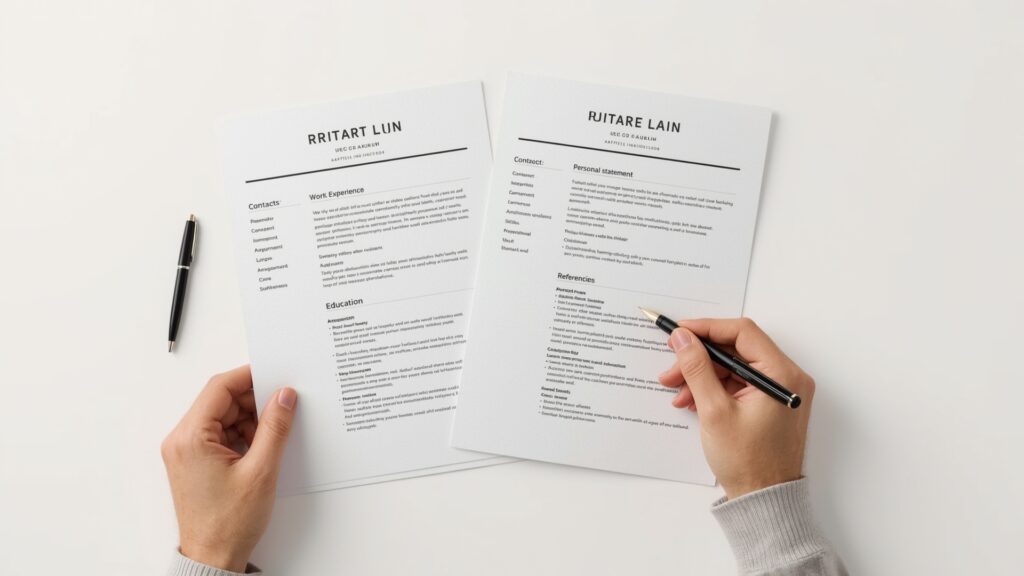
In the UK, a CV is the standard document used to apply for most jobs across sectors. It’s different from a resume, which is commonly used in countries like the US or Canada. A UK CV format focuses more on career details and is usually longer, up to two A4 pages.
Unlike a resume that summarizes, a CV presents a full picture of your education, qualifications, career goals, and work placements. This makes it particularly useful for both graduate and experienced job seekers.
Whether you’re applying for a graduate internship, switching industries, or returning to the workforce after a gap, learning how to write a CV tailored to UK standards is essential.
CV Format UK: What Recruiters Expect in 2026
Make sure your CV is presented cleanly and maintains a professional appearance. Stick to traditional formatting guidelines that support both ATS-friendly CV processing and human readability.
Format guidelines:
- Use clean, professional fonts like Calibri, Arial, or Times New Roman, in 11–12 point size. The National Careers Service advises a clear font in size 11 or bigger, and the same style throughout.
- Use a steady spacing style and outline tasks with clear bullet points.
- Use clear headings — “Work Experience”, “Education”, “Skills” — so a recruiter and a computer can both find each section.
- Avoid images, logos, colours, or graphics. They add nothing and they confuse applicant tracking systems.
- Save your file as a PDF unless the advert or the employer asks for a DOCX — PDF keeps your formatting exactly as you set it. If an employer asks for Word, send Word.
- You can use an online CV builder to help structure the document, but remember: your words and relevance still matter more than any design.
ATS formatting box — how to pass the automated filter
Most large UK employers run CVs through an applicant tracking system (ATS) before a person ever sees them. A CV that the system cannot read is rejected no matter how good the experience is. To pass it:
- One column only. No tables, no text boxes, no headers or footers with key information in them — the system reads top to bottom, left to right, and skips what sits outside the main body.
- Standard headings. Use “Work Experience”, “Education”, “Skills” — not clever alternatives. The system looks for those exact words.
- Keywords from the advert. If the advert says “stock control” and “rota management”, use those exact phrases in your work history. The system matches words, not synonyms.
- Plain fonts, plain bullets. Arial or Calibri, simple round or dash bullets, no icons or symbols.
- No images, charts or graphics. A photo, a skills bar or a logo can break the parse entirely.
- PDF unless DOCX is requested. Send the format the advert asks for; if it says nothing, send PDF.
Include Only Relevant Personal Information
Your personal information sits at the top of your CV. UK employers are careful about privacy and anti-discrimination, so only include what’s necessary.
Include:
- Full name
- Phone number
- Email address — a plain, professional one (firstname.lastname@ is enough)
- Your LinkedIn profile link, if it is complete and up to date.
- Your town or city — enough for an employer to judge the commute; never your full home address
Leave out:
- Age or date of birth
- Nationality or marital status
- Headshot / photo
- Your full home address
- Your National Insurance number — an employer only needs it after offering you the job
Why this matters — the Equality Act 2010. Age, marriage or civil partnership, and race — which includes nationality — are protected characteristics under the Equality Act 2010. An employer must not discriminate against you because of them, and the National Careers Service advises you not to put them on your CV at all. Leaving them off is not hiding anything: it keeps the decision about your skills, not about who you are.
Checks before you send — the Equality Act and ATS rules
- Equality Act 2010: age, marriage or civil partnership, and race (including nationality) are protected characteristics. Do not put your age, date of birth, marital status, nationality or a photo on your CV. The National Careers Service advises exactly this.
- ATS check: one column, standard headings (“Work Experience”, “Education”, “Skills”), no tables, text boxes, headers, footers, images or graphics, plain fonts (Arial or Calibri), and the advert’s own keywords in your work history.
- File check: PDF unless the advert asks for DOCX.
- Proof check: someone else has read it; every date, phone number and email address is correct; your LinkedIn profile matches the CV.
Writing a Strong Personal Statement for Your CV

Directly under your contact details, add a short personal statement — usually 2–4 lines — that introduces your professional self. The National Careers Service calls this the introduction: a few short lines that sum up who you are and what you hope to do, placed just under your name and contact details.
This section should answer:
- What role are you targeting?
- What makes you a strong fit?
- What industry or area are you applying to?
Example:
“Logistics specialist with five years’ experience optimising supply-chain workflows and leading small teams to meet tight deadlines. Now seeking an operations role with a national firm, where I can use my route-planning and team-leadership experience to cut delivery times and costs.”
Use this section to communicate your career intentions, key strengths, and enthusiasm — without repeating your CV word for word. If you can swap your name for anyone else’s and the statement still fits, it is too generic: rewrite it with one fact that is only true of you.
How to Write Education History in CV
If you’re early in your career or recently graduated, your educational qualifications should appear near the top. If you have more experience, you can go below the work section.
Format it as:
- Name of qualification
- Institution (school, college, or university)
- Dates attended
- Grades (only if relevant or recent)
Use clear subheadings like “Education” or “Academic Qualifications” to guide the reader.
How to Describe Work Experience in a CV

This is one of the most critical sections. Start with your current or most recent job, then list previous roles in descending order.
For each job, include:
- Job title
- Employer name
- Start and end dates
- Provide three to four bullet points outlining your tasks and the impact you made.
Use the STAR method CV technique: Situation, Task, Action, Result. This helps demonstrate real impact.
Example:
- Coordinated daily transport schedules across three regions, improving delivery time by 15%
- Managed a team of five drivers and handled customer service escalations
Even unpaid roles like voluntary work, student placements, or internships are valid and should be included in a work experience CV.
How to Adjust Your CV to Fit the Role
Recruiters are looking for alignment. That’s why one of the most vital CV writing tips is to tailor your CV to each role you apply for. This doesn’t mean rewriting everything — it means adjusting:
- The personal statement to match the job
- The skills listed, to mirror the job description
- The work achievements you lead with, to fit what the company values
Check every job advertisement carefully, and edit your CV to reflect the keywords and phrasing used. This increases your chances of being shortlisted, shows you’re serious about the opportunity — and, as the ATS box above explains, it is also what gets your CV past the automated filter. One CV sent to twenty jobs is easy to spot, and it is the single most common reason good candidates hear nothing back.
Free CV Builders and Templates: Which to Use?
If you’re unsure where to start, a free CV template or an online CV builder will give you the structure. Each has its pros.
CV builder — best if you’re unfamiliar with formatting:
- Barclays LifeSkills CV Builder — a free, step-by-step tool: fill in each section (personal statement, education, work experience, skills) and download your CV as a Word document. You need a free LifeSkills account, and it takes at least 30 minutes to do properly. It can also connect to your Facebook and Twitter accounts to pull in skills and interests — check anything it pulls in before you submit it. (LifeSkills CV Builder)
- DWP CV builder — the Department for Work and Pensions has a new CV builder tool to help you build a CV from scratch. (DWP CV builder)
- Builders usually include prompts for each section and let you preview and download in Word format.
Free CV template — best if you’re comfortable with Word or Google Docs:
- More flexible, and good if you want to customise the design.
- Commonly used when aligning your CV to specific job requirements.
Start with the official advice first. Before you open any builder, read the National Careers Service guide to how to write a CV — it sets out the sections, the formatting, and what to leave off, in the government’s own words.
Many job seekers start with a builder and then personalise the document before applying. Whichever route you take:
- Include only qualifications, experience, and achievements that match the role.
- Make sure any social-media information pulled in is appropriate and clean.
- Export the final result in a format that’s easy to open and print — PDF unless the employer asks for DOCX.
- Never pay for a CV builder upfront. The tools above are free; any site that asks for payment before you can download your CV is one to walk away from.
Key Skills and Achievements That Strengthen a UK CV
A standout CV doesn’t just list job titles; it showcases what you’re good at and how you add value. Whether you’re applying for an entry-level job or a senior role, highlighting your key skills and achievements helps employers see your potential beyond basic duties.
This part of your CV should reflect practical expertise as well as communication, teamwork, or leadership skills. Use bullet points for clarity and keep them relevant to the job.
Examples of In-Demand CV Skills:
- Time management and organization
- Project coordination
- Digital tools proficiency (e.g., Excel, CRM systems)
- Written and verbal communication
- Problem-solving
- Adaptability
- Team leadership
Achievements are results you’ve contributed to; quantify them where possible. For instance, “increased social media engagement by 30 percent in three months” is more effective than just “managed social media”.
Adding a section specifically titled Key Achievements can help your CV for a job application stand out in competitive fields.
Don’t Forget the Cover Letter
A CV gets you shortlisted; a cover letter gets you noticed. Many UK employers still expect one, and skipping it when one is asked for is an easy way to be filtered out. A UK cover letter is short — about one A4 page, three or four paragraphs — and it does a different job from the CV: it explains why you want this role, at this company, right now.
How to write it:
- Address it to a named person where you can find one — the hiring manager’s name is usually in the advert or on the company’s website. If you genuinely cannot find a name, “Dear Hiring Manager” is better than “Dear Sir/Madam”.
- Paragraph 1: the role you’re applying for and where you saw it, in one or two lines.
- Paragraph 2: your two or three strongest, most relevant achievements — with a number where you have one. This is the evidence, not a repeat of your CV.
- Paragraph 3: why this company. One specific thing — a project, a value, a recent change — that shows you researched them.
- Close: say you’re happy to discuss the role, give your phone number, and sign off “Yours sincerely” if you addressed a named person.
Cover-letter mistakes to avoid: repeating your whole CV; writing “I am a team player” with no example; using the same letter for every job — a cover letter that could be sent to any employer convinces no employer. Tailor it the same way you tailor the CV (§C5). The National Careers Service guide to how to write a CV is the starting point; the LifeSkills CV Builder also covers covering letters.
How to Update Your CV the Right Way
If you already have a CV but haven’t reviewed it in a while, it’s time to update your CV. Employers notice when a document feels outdated or irrelevant.
What to check when updating:
- Are your most recent roles and achievements included?
- Have you removed old or unrelated jobs?
- Is your contact information current?
- Does your statement reflect your current goals?
Regular updates not only improve your presentation but also show you’re career-minded and proactive. Keeping your CV builder document saved online allows for quicker edits each time you apply.
What Makes a Good CV in the UK?
A strong CV has three key qualities: clarity, relevance, and structure. The best way to write a CV is to think like a hiring manager: What would they want to see within the first 15 seconds?
What makes a good CV:
- Focused on the job you’re applying for
- Easy to navigate with clear headings and layout
- Free from grammar or spelling errors
- Demonstrates real outcomes, not just responsibilities
- Contains no unnecessary jargon or fluff
When you’re figuring out how to make your CV stand out, always ask: “Does each section earn its space on the page?”
How to Build a Strong CV for Beginners
Starting from scratch can be intimidating, especially for students or those entering the job market for the first time. The good news is that CV writing for beginners can still result in a professional, job-winning profile with the right approach.
Follow these steps:
- Begin with a basic outline using a free CV template
- Include personal details, a short personal statement, education history, and any work placements.
- Highlight transferable soft skills from coursework, group projects, or volunteering.
- Don’t leave blank sections if you have no paid work, focus on academic achievements or part-time jobs.
Every skill counts when structured correctly. For example, being a captain of a sports team shows leadership and time management.
What Employers Expect in a UK Job CV
The structure of your CV should align with what UK employers expect to see. A clear format helps recruiters find what they need quickly and improves your chances of interview selection.
Essential sections:
- Full name and contact details
- A personalized personal statement for a CV
- Educational background
- Work history, listed in reverse order
- Skills and achievements
- Voluntary roles or side projects (if applicable)
- Optionally, mention: “References available on request”
You can review CV examples UK in your industry to see how successful candidates structure theirs.
Addressing Gaps in Employment on a CV
Taking a break from work has become increasingly normal, whether it’s for health, study, travel, or personal matters. When dealing with an employment gap, the key is to remain honest and clear.
Strategies to address gaps:
- Briefly explain the gap within your work history
- Mention any freelance work, short courses, or certifications completed during that period.
- Focus on adaptable skills acquired through any experience, not just formal jobs.
Example: Stepped away from work to care for a family member and invested the time in completing certified online courses in digital marketing.
Being upfront shows maturity and foresight, qualities employers appreciate.
Tailoring is covered above — see ‘How to Adjust Your CV to Fit the Role’.
LinkedIn CV Profile: Should You Include It?
Including your LinkedIn CV profile on your document is now expected by many employers. It offers a more complete view of your professional background and connections.
Make sure your profile:
- Matches the details on your CV
- Has a professional photo
- Includes endorsements or recommendations, if possible
More than just a profile, it becomes part of your job seeker identity and helps recruiters find you even outside of the direct application process.
What Is the Best Way to Write a CV in the UK?
There’s no single way, but best practices include:
- Following the UK CV format
- Matching your content to the job
- Using proper grammar and structure
- Being honest and concise
How Many Pages Should a UK CV Have?
A common question among job seekers is: how long should a CV be? The general rule for most UK industries is no more than two A4 pages. The National Careers Service sets no page limit of its own — it asks for a CV that is clear, to the point and easy to scan — but two pages is the standard UK employers expect, and it is the limit this guide recommends.
There are some exceptions:
- Students and recent graduates may use a one-page CV. With limited work history, one strong page beats two thin ones.
- Senior professionals with over 10 years of experience may need a full two pages — and two pages is the ceiling, not the target.
- Academic or research roles are the main exception: longer CVs are accepted, because publications and research history have to be listed.
Keep each section meaningful and avoid repetition. Recruiters should be able to grasp your qualifications and career history quickly — if a line doesn’t earn its space, cut it.
How to Make Your CV Stand Out
With hundreds of CVs being reviewed for a single role, standing out is vital. The goal is to show both relevance and value.
Strategies that work:
- Begin Your CV with a Clear and Impactful Personal Statement
- Use action verbs in your work experience section.
- Back up your accomplishments with data, like ‘improved efficiency by 20%.
- List only job-related soft skills and hard skills.
- Match your keywords to the job posting.
Tailoring your CV is one of the most effective ways to differentiate yourself. Employers can tell who took the time to truly understand the role.
What Is a Good CV Format for Online Job Applications?
See also the ATS formatting box above.
Online job portals often use applicant tracking systems (ATS), which means your CV must be formatted to pass automated filters.
Use this checklist for an ATS-friendly CV:
- Use .docx or PDF formats (unless stated otherwise)
- Avoid tables or headers that confuse parsing tools.
- Use clear headings like “Work Experience” or “Education”
- Include bullet points in your CV for duties and achievements.
- Stick to basic fonts such as Arial or Calibri.
Avoid inserting unnecessary visuals or graphics that interfere with scanning. A clean structure is your best tool.
How to Use the STAR Method in CV Writing
The STAR method CV strategy helps you express your responsibilities and impact more effectively.
S – Situation
T – Task
A – Action
R – Result
Better than saying ‘Handled inventory for a store’:
“Managed inventory system (Situation), ensuring stock levels remained balanced (Task), by introducing weekly audits (Action), resulting in a 25 percent reduction in product shortages (Result).”
This helps hiring managers see your contribution and potential.
What to Do Before Submitting Your CV

Whether you’re submitting a printed version or uploading it to a recruitment platform, take a final pass through the document.
Final steps:
- Grammar check and spell check in every section
- Review formatting for alignment, font consistency, and spacing
- Ensure dates are correct and consistent.
- Match content with your LinkedIn CV profile.
- Have a second pair of eyes review it.
Minor typos or inconsistencies can weaken even the strongest CV.
Common Mistakes to Avoid in CV Writing
Even experienced professionals make avoidable CV mistakes. Here are some to watch out for:
- Using outdated contact details
- Leaving unexplained gaps with no context
- Writing in dense paragraphs instead of listing key points
- Overloading the CV with jargon or personal hobbies
- Forgetting to tailor your CV for each application
- Using an unprofessional email address
Review your CV sections thoroughly and aim for clarity, not cleverness.
Final CV Writing Checklist
Review the following checklist to confirm your CV meets professional standards before submission:
- Have I used the correct UK CV format?
- Is my statement for my CV tailored to the job?
- Did I include all relevant work experience CV entries?
- Are qualifications, certifications, and voluntary work listed?
- Have I removed outdated or irrelevant content?
- Did I match my CV with the job advertisement keywords?
- Is the grammar check and spell check complete
- Does my LinkedIn profile match the details in my CV?
Completing this checklist boosts your confidence and your chances of getting shortlisted.
Is Your CV Ready to Send?
Learning how to create a CV UK employers will read is a career investment. From layout and content to tailoring and proofing, every element counts — and the test is simple: hand it to someone who doesn’t know you and ask them, after 15 seconds, what job you’re applying for and why you’d be good at it. If they can’t answer, the CV isn’t ready.
Build it with the free tools in this guide — the National Careers Service advice, the LifeSkills CV Builder or the DWP CV builder — tailor it to each role, and keep it updated as you gain experience. A thoughtfully prepared CV is not just about getting a job; it’s about showing who you are and where you’re headed.
How to write a CV in UK format?
Use a clear, professional layout with consistent headings. Start with contact details and a short personal statement. Follow with education history, work experience, skills, achievements, and references — in that order, most recent first. Keep it to two A4 pages, in one column, with standard headings. Save as PDF or.docx (PDF unless the employer asks for Word).
How to make a CV in the UK for free?
Use the free tools in this guide: the Barclays LifeSkills CV Builder (free account, downloads as a Word document) or the DWP CV builder, and read the National Careers Service guide to how to write a CV first. Never pay a site that asks for payment before you can download your CV.
Which CV is used in the UK?
The UK uses a detailed CV of up to two A4 pages — not a one-page resume. It includes contact details, a short introduction, education history, work history, key skills and achievements, and references, formatted for easy scanning.
What is the best CV builder in the UK?
There is no single best builder — it depends on what you need. The LifeSkills CV Builder (Barclays) and the DWP CV builder are both free and both produce a standard UK-format CV. Pick the one whose prompts suit you, then personalise the result: a builder gives you structure, not content.
What should I leave off a UK CV?
Your age, date of birth, marital status, nationality, photo, full home address and National Insurance number. Age, marriage and nationality are protected characteristics under the Equality Act 2010, and the National Careers Service advises leaving them off. Give your town or city only, and keep your National Insurance number for after you get an offer.
How do I make my CV pass an ATS filter?
Use one column, standard headings (“Work Experience”, “Education”, “Skills”), no tables, text boxes, images or graphics, a plain font such as Arial or Calibri, and the exact keywords from the job advert in your work history. Save as PDF unless the advert asks for DOCX.
Sources checked: National Careers Service — How to write a CV (sections, formatting, what to leave off, gaps, references, STAR method); Department for Work and Pensions CV builder tool (via the National Careers Service page); Barclays LifeSkills CV Builder (free tool, Word download, free account, 30+ minutes, Facebook/Twitter connect); GOV.UK — Discrimination: your rights (Equality Act 2010 protected characteristics: age, marriage/civil partnership, race including nationality); Prospects — How to write a CV (already linked in the post). All sources checked 9 November 2026. Rules and tools change — check the linked source before you rely on a detail.






4 Responses